

What is Hospice Care? A Guide to Finding Comfort in Northeast Wisconsin
Hospice care is a specialized philosophy of care dedicated to prioritizing quality of life for individuals with a life-limiting illness. In Wisconsin, eligibility requires two physicians to certify a prognosis of six months or less if the disease follows its natural course. Rather than seeking a cure, hospice focuses on managing pain and symptoms while providing deep emotional and spiritual support. Hospice care is typically 100% covered through a benefit under Medicare, Medicaid, and private insurance. Care is delivered wherever the patient calls home, whether that is a private residence, a nursing facility, assisted living facility, hospital, or Unity Jack and Engrid Meng Hospice Residence.
The Decision No One Wants to Make (But Everyone Deserves)
Facing the reality of a terminal diagnosis is perhaps the most isolating experience a family can go through. The doctor’s office suddenly feels colder. The medical jargon such as prognosis, palliative, intervention starts to blur together. You might feel like you are standing on the edge of a cliff, unsure of how to move forward without falling.
But here is the truth that often gets lost in the fear: You do not have to jump. There is a bridge.
At Unity Hospice, we have been the region's trusted care partner for decades. As the first hospice established in Wisconsin (dating back to 1977) and the area’s only non-profit partnership, we help families across Northeast Wisconsin find clarity in the confusion. We know that the word "hospice" can feel heavy. It can feel like a door closing. But for the thousands of families we have served in Green Bay, the Fox Valley, and Door County, it actually opens a window—a window to relief, to dignity, and to finally being a family again, rather than just patients and caregivers.
This guide is written to answer the questions you might be afraid to ask, explain what is hospice care in plain language, and help you understand why choosing support early isn't about giving up; it's about getting expert help to give you peace of mind so when the end comes, you know you did everything possible.
Part 1: Defining the Care
It’s Not a Place; It’s a Philosophy
One of the most persistent myths we encounter is the idea that "hospice" is a building you go to when there is no hope left. While we are proud to offer the region's first dedicated hospice residence (which we will discuss later), hospice itself isn’t a place. Instead, it’s specialized, holistic care for the patient and family that comes to you.
Think of it this way: In a hospital, the goal is often to cure the disease, sometimes at the cost of comfort. In hospice, the goal is to care for the whole person-medically, emotionally, and spirituality - ensuring comfort at all costs.
We bring the expertise associated with a hospital room such as pain management, medical equipment, nursing assessments directly to your favorite armchair, your bedside, or your front porch. Whether you live in a farmhouse in Shawano, an apartment in Appleton, or an assisted living facility in Sturgeon Bay, the care comes to you.
What Does Hospice Actually Do?
Hospice is specialized medical care for people with a life-limiting illness. But unlike standard medical treatment, the goal isn't to cure the disease; it’s to manage the symptoms that are causing a decrease in the patient’s quality of life (pain, anxiety, shortness of breath, and nausea).
Think of hospice as a "wrap-around" layer of support. It is a philosophy of care that treats the person, not just the disease.
Where is Care Provided?
A common misconception is that "hospice" is a building. While Unity does offer a dedicated inpatient hospice facility, hospice is primarily a service that comes to you wherever you live..
- At Home: 98.8% of hospice days nationally are "Routine Home Care." We come to your private residence, whether that's a farmhouse in Shawano or an apartment in downtown Appleton.
- Assisted Living & Nursing Homes: We partner with facilities across our 14-county service area to provide an extra layer of one-on-one care that facility staff often cannot provide.
- Inpatient Care: For complex symptom management, we offer care at our Jack and Engrid Meng Hospice Residence in De Pere, the area’s first dedicated inpatient
- hospice facility featuring private suites and 24/7 skilled nursing.
- Hospital: Unity is the sole provider of inpatient hospice at seven area hospitals including Bellin Green Bay Hospital, Bellin Oconto Hospital, HSHS St. Clare Hospital, HSHS St. Mary’s Hospital Medical Center, HSHS St. Vincent Hospital, Marinette Aurora Bay Area Medical Center, and Door County Medical Center.
Hospice vs. Palliative Care: Clearing the Confusion
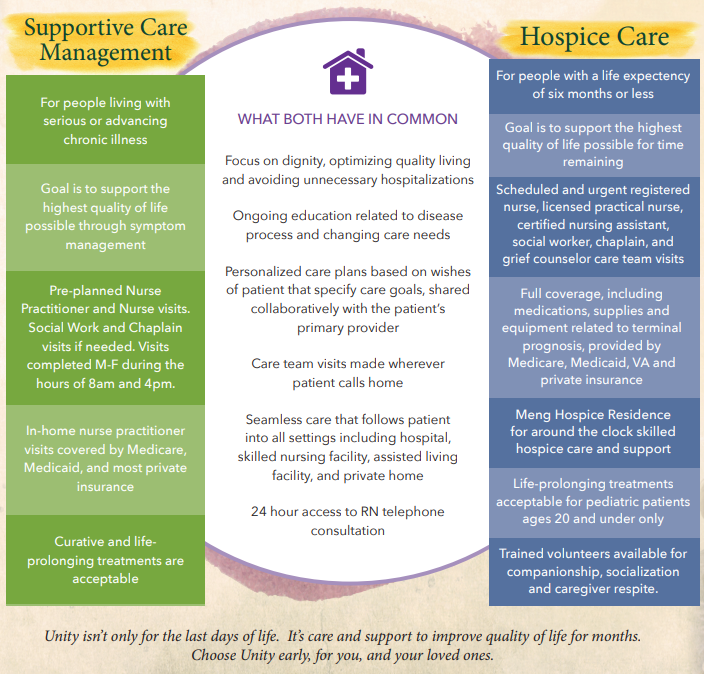
You will often hear these two terms used interchangeably, but there is a critical difference. Understanding hospice vs palliative care can save you months of uncertainty.
- Palliative Care: This is the broader umbrella. It is specialized medical care for people at any stage in a serious illness. The key difference? You can receive palliative care while you are still receiving life-prolonging treatment. You might be undergoing chemotherapy or dialysis and still have a palliative care team helping provide relief from the symptoms and stress of the disease.
- Hospice Care: This is a specific type of palliative care for the end of life. It begins when life-prolonging treatment stops, either because it is no longer working or because the patient decides they are tired of the side effects. It is reserved for patients with a prognosis of six months or less.
If you are struggling to decide which path is right, our guide on Palliative Care vs Hospice Care explores these differences in depth.
Part 2: Who Is It For? (It’s Not Just for Cancer)
Decades ago, hospice was primarily associated with cancer patients. Today, that picture has changed dramatically. While we still care for many oncology patients, hospice eligibility in Wisconsin covers a vast range of chronic, progressive conditions.
We frequently see patients who are "tired of the cycle", the constant trips to the ER for fluid buildup, the late-night panic attacks from shortness of breath, or the exhaustion of managing complex medications. It is not just for cancer. While cancer is a common diagnosis, it accounts for only about 30% of hospice admissions.
Common Qualifying Conditions Include:
- Heart Disease: Specifically Congestive Heart Failure (CHF) and late-stage coronary disease.
- Lung Disease: COPD, Emphysema, and Pulmonary Fibrosis.
- Dementia & Neurological Conditions: Alzheimer’s, Parkinson’s, ALS, and stroke recovery.
- Organ Failure: End-stage kidney or liver disease.
- General Decline: Sometimes simply called "Failure to Thrive," where a patient is losing weight and functional ability despite medical efforts.
The "Six Month" Rule Explained: To qualify, a doctor must certify that if the disease runs its normal course, life expectancy is six months or less. But here is the secret: Doctors do not have a crystal ball. If a patient lives longer than six months (which often happens because the personalized care improves the patient’s health!), they are not “kicked out” of receiving the service. As long as the patient continues to meet medical criteria for decline, the patient can remain on hospice indefinitely.
Read more about this surprising fact here: Myth: Hospice is Only for the Last Days of Life
Part 3: The Unity Difference – Who Comes to Your House?
Unity Hospice operates much differently than for-profit, national hospice chains. While both nonprofit hospices and for-profit hospices are held to the same basic licensing and regulatory requirements, the way they prioritize resources, measure success, and approach patient care differ greatly. The mission of nonprofit hospice providers like Unity is centered on people, not profits. Nonprofits reinvest every dollar earned back into patient care, family support, and community services. For-profit hospice providers are in business to make money and pay dividends to stockholders. While many employ caring professionals, their primary obligation is to grow profits. For-profit hospices often seek to increase profits by lowering operational costs, which involve reducing the frequency of patient visits, decreasing staffing ratios, and limiting expenditures on patient care services such as grief support and specialized programs that are not reimbursed by Medicare and insurance. They worry more about the cost of caring for a patient rather than the care they are providing.
Unity is a non-profit partnership of Bellin Health, St. Mary’s Hospital, and St. Vincent Hospital. This means we are locally owned, and every dollar goes back into patient care, not to remote shareholders.
When you choose Unity, you aren't just hiring a nurse. You are hiring a village. We operate on an "Interdisciplinary Team" model. This holistic approach is why 54.3% of Medicare decedents in Wisconsin chose hospice care in 2022, ranking our state 4th in the nation for hospice utilization. Wisconsin families understand the value of support. Here is who will be knocking on your door:
1. The Nurse Case Manager (The Anchor)
Your registered nurse is your main point of contact. They work with you and your family to develop a plan of care according to your needs, wishes, and goals. They visit regularly to check vitals, assess pain, and manage the physical symptoms of illness. They are the ones who notice the little changes, a cough that sounds different, a new grimace of pain, and adjust medications instantly. Learn more about the role of nurses in Hospice in Home Care: A Nurse’s Perspective.
2. The Social Worker (The Navigator)
Your social worker is specially trained to help you and your family address social, emotional and practical challenges as they arise during care. They advocate for you and your family so you can get through the “red tape” and get tapped into necessary community resources . They help with::
- Completing Power of Attorney and Advance Directive forms.
- Navigating insurance benefits and finding community resources.
- Facilitating those "hard conversations" between family members who might disagree on care.
- Educating on disease progression and the end-of life process
- Assessing caregiver burnout and offering support
3. The CNA (The Hands of Care)
Often the family's favorite team member, the Certified Nursing Assistant helps with the intimate tasks of daily living: bathing, dressing, changing linens, and light meal prep. They bring dignity to the moments that can feel most vulnerable.
4. The Chaplain (The Listener)
You don't have to be religious to benefit from spiritual care. Our chaplains are there to support your human spirit. Whether you want to pray, read scripture, or simply talk about your fears, regrets, and hopes, they provide a safe, non-judgmental space.
Part 4: The Fear of "Morphine" and Other Myths
We cannot talk about hospice without addressing the elephant in the room: the fear of medication. Families often whisper, "If we start morphine, does that mean it’s the end?" or "Will they just be sleeping all the time?"
These fears are valid, but they are often based on misconceptions.
- Myth: Morphine hastens death.
- Fact: When used correctly, morphine relieves pain and "air hunger" (the scary feeling of not being able to catch your breath). By relaxing the body and reducing stress, it often allows the patient to rest peacefully, not rush the end.
- Myth: Hospice starves patients.
- Fact: As the body shuts down, it naturally stops needing food. Force-feeding a dying patient can actually cause bloating and nausea. We follow the patient's lead, offering food for pleasure, not for calories.
For a deeper dive into medication safety, read our article on The Myths of Morphine in Hospice Care and Myth: No More Medications.
Part 5: The "Early" Advantage
If there is one message we wish we could broadcast to every family in Wisconsin, it is this: Don't wait for the crisis.
The benefits of early hospice enrollment are staggering. When you call us in the final 48 hours of life, we can help, but our role is limited to emergency crisis management. We are rushing to get pain under control.
According to the March 2025 MedPAC Report to Congress, the median length of stay in hospice is only 18 days. That is simply too short for the patient and family to benefit from our full breadth of services..
When you call us months in advance, we can:
- Build Relationships: Your loved one gets to know their nurse and aide, building trust and comfort.
- Prevent 911 Calls: We teach you what to expect, so when a symptom changes at 2 AM, you call us instead of rushing to the ER.
- Manage "Total Pain": We have time to address emotional pain, financial stress, and spiritual anxiety, not just physical symptoms.
- Create Memories: When pain is managed, patients have the energy to tell stories, and fully engage and enjoy family time..
Research consistently shows that patients live longer on hospice than those who pursue aggressive treatment.
Wondering if it's the right time? Read: Why Hospice? Why Now?
Part 6: Where Care Happens (The Jack and Engrid Meng Hospice Residence)
While most of our patients remain at home, sometimes care needs become too complex for family caregivers to handle alone. In these instances, Unity offers a unique resource to our community: the Jack and Engrid Meng Hospice Residence.
Located in Ledgeview, just outside De Pere, this is not a hospital and it is not a nursing home. It is a sanctuary. Featuring private suites, patios opening to beautiful gardens, and family gathering spaces, it offers 24/7 acute symptom management. It is a place where families can stop being caregivers and start being families again, knowing the medical details are handled by experts.
Part 7: Financial Peace of Mind
"Can we afford this?" The short answer is: Yes.
Hospice is one of the only benefits in the American healthcare system that covers nearly everything.
- Medicare & Medicaid: Cover 100% of the cost. This includes the visits from the team, the medications related to the diagnosis, the hospital bed, the oxygen, the wheelchair, and the incontinence supplies.
- No Copays: Generally, there are $0 deductibles and $0 copays for hospice services under Medicare.
- Unity's Non-Profit Mission: As a non-profit, we are mission-driven, not profit-driven. If a patient is eligible for care but has no insurance or ability to pay, we are committed to helping them.
For a detailed breakdown of costs, visit: Who Pays for Hospice Care?
Local Care: The Unity Difference
Unity Hospice is the only locally-owned, non-profit hospice partnership in the region (partnered with Bellin Health, St. Mary’s, and St. Vincent Hospital).
We are not a national chain managed from a corporate office in another state. We are your neighbors. We have a 49-year track record of providing care to the community. Hospice providers deeply embedded in their communities like Unity have been shown to deliver the highest quality of care.
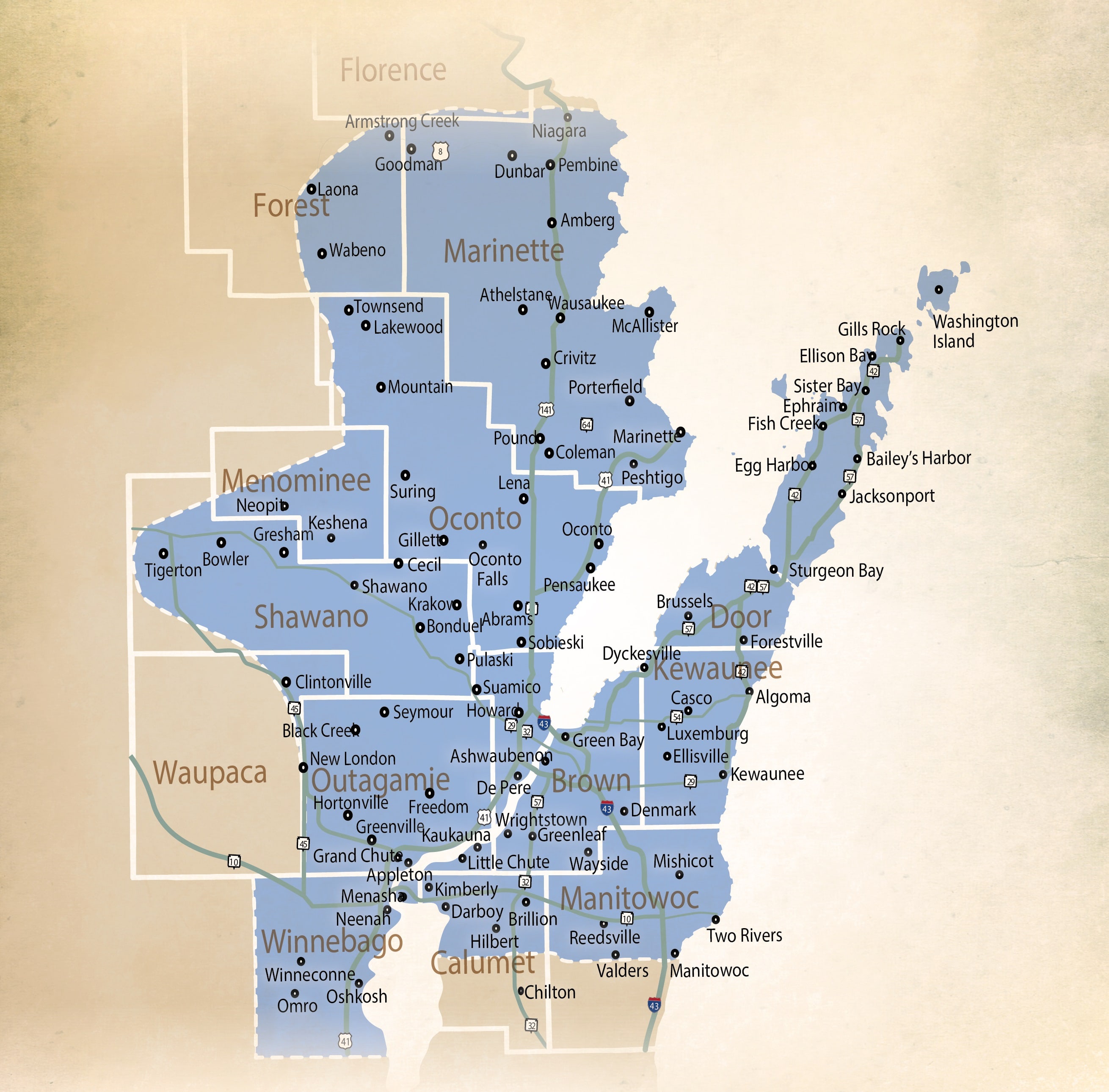
Our 14-County Service Area Includes:
- Brown County: Ashwaubenon, De Pere, Green Bay, Greenleaf, Howard, Pulaski, Suamico, Wayside, Wrightstown
- Calumet County: Brillion, Darboy, Hilbert, Kimberly
- Door County: Brussels, Egg Harbor, Ellison Bay, Ephraim, Fish Creek, Forestville, Gills Rock, Forestville, Jacksonport Sister Bay, Sturgeon Bay, Washington Island
- Florence County:
- Forest County: Armstrong, Laona, Wabeno
- Kewaunee County: Algoma, Casco, Ellisville, Kewaunee, Luxemburg
- Manitowoc County: Manitowoc, Mishicot, Two Rivers, Reedsville, Valders
- Marinette County: Amberg, Athelstane, Coleman, Crivitz, Dunbar, Goodman, Marinette, McAllister, Niagara, Pembine, Peshtigo, Porterfield, Pound, Wausaukee
- Menominee County: Keshena, Neopit
- Oconto County: Abrams, Gillett, Lakewood, Lena, Mountain, Oconto, Oconto Falls, Pulaski, Sobieski, Suring, Townsend
- Outagamie County: Appleton, Freedom, Grand Chute, Hortonville, Kaukauna, Little Chute, Seymour, New London, Black Creek
- Shawano County: Bonduel, Bowler, Gresham, Krakow, Pulaski, Tigerton, Shawano
- Waupaca: Clintonville
- Winnebago County: Menasha, Neenah, Omro, Oshkosh, Winneconne
Because we are local, we know the local healthcare landscape. We have long established relationships with area hospitals, assisted living facilities, nursing homes, and pharmacies throughout Northeast Wisconsin, ensuring seamless transitions of care in every setting.
Taking the First Step
Reading this article was the first step. You are gathering information, and that is a brave thing to do. The next step doesn't have to be a commitment; it can just be a conversation.
You do not need a doctor’s referral to request a consultation. If you are noticing a health decline with your loved one, such as losing weight, sleeping more, or struggling with pain, you can call Unity directly. We can sit down with you in person or discuss your loved one’s condition on the